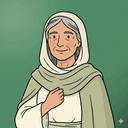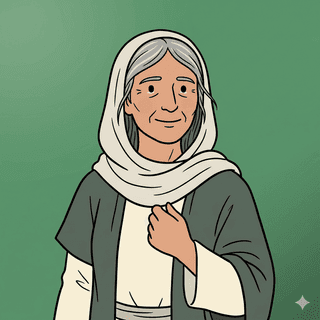
Naomi
“Call me Mara — bitterness.”
A mother who starts over after losing her whole family, and through whom the Messiah's lineage continues.
Naomi was originally from Bethlehem. But when a famine came, she took her husband Elimelech and two sons, Mahlon and Chilion, and left for Moab — a decision made for safety. Before ten years had passed there, she lost everything. Her husband died, then both sons died. Only she and her two daughters-in-law were left — three widows with nowhere clear to go.
She decided to return home and urged her daughters-in-law, 'Go back, each of you, to your mother's house.' Orpah went back, but Ruth stayed with her to the end. When the two women arrived in Bethlehem, the whole town stirred: 'Is this Naomi?' She answered, 'Do not call me Naomi [pleasant]; call me Mara [bitter], for the Almighty has dealt very bitterly with me. I went away full, and the LORD has brought me back empty.' An honest cry that didn't dress up her grief.
Yet she wasn't trapped by grief. She encouraged Ruth when she went out to glean, and when she heard Ruth had ended up in Boaz's field, she recognized him as a relative. She taught Ruth the law of kinsman-redemption and explained the customs of the threshing floor. Even where her own life had collapsed, she helped build the way forward for the next generation. When Ruth gave birth to Obed, the women of Bethlehem said to her, 'Blessed be the LORD... he is a restorer of your life and a nourisher of your old age.' When she held that child in her arms, her bitterness (Mara) turned back into pleasantness (Naomi). And that child, Obed, was the father of Jesse, and Jesse the father of David.
She returned home empty after losing her husband and two sons. Even in deep grief, she released Ruth wisely and welcomed family again.
Defining Moments
The events that made this person who they were
Fleeing famine to Moab, then losing her whole family
After leaving Bethlehem to escape a famine and settling in Moab, her husband Elimelech dies, and then both her sons die. A tragedy where she lost everything in the very place she'd gone seeking safety.
Returning to Bethlehem and crying out, 'Call me Mara'
Back in her hometown, she cries out to the people, 'Do not call me Naomi; call me Mara, for the Almighty has dealt very bitterly with me.' An honesty that doesn't hide her pain.
The mother-in-law who shows Ruth the way forward
She encourages her gleaning daughter-in-law, recognizes that Boaz is a relative, and teaches her the customs of the threshing floor. In the midst of her own loss, she still helps build the way for the next generation.
Personality
The colors revealed through their story
Someone who speaks her grief honestly
When she returns home, she asks the people to change her very name. An honesty that never dresses up grief.
Yet someone who isn't trapped by grief and still looks after the next generation
Even where her own life has collapsed, she helps build her daughter-in-law's path forward. A mother's instinct for shaping the next place even from the last.
Someone who deeply knows her homeland and family customs
The law of kinsman-redemption, the custom of the threshing floor, who Boaz is — her knowledge becomes the bridge connecting Ruth and Boaz.
★ Strengths
- Honesty that does not deny sorrow
◐ Shadow
- The season of loss becoming identity
💡 On mobile, tap [Share] to send instantly via Messages, Instagram DM, and more.